AI Agents vs Chatbots: When Autonomous AI Actually Pays Off
AI agents vs chatbots explained — what really separates an autonomous AI agent from a chatbot, when agents are worth the cost, and when a simple chatbot wins.
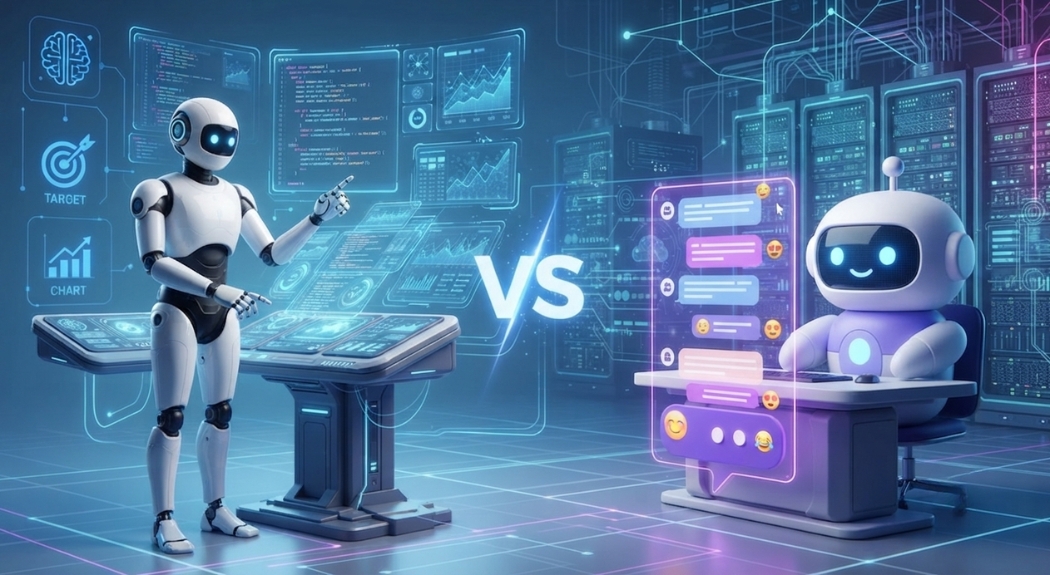
"AI agent" is the most overused phrase in software right now. Vendors slap it on everything, and it has quietly become a synonym for "chatbot, but more expensive." That confusion costs companies real money — they build complex autonomous systems for problems a simple chatbot would have solved, or they ship a basic chatbot for a problem that genuinely needed an agent. Knowing the difference is how you avoid both mistakes.
The real difference
A chatbot responds. You send a message, it replies. Even a very good chatbot built on a large language model is fundamentally a request-and-response system: it answers questions, retrieves information, and holds a conversation, but it does not independently decide to do things in the world.
An AI agent acts. Given a goal, it plans a sequence of steps, chooses and calls tools (APIs, databases, other services), observes the results, and adjusts — looping until the goal is met or it decides it cannot proceed. The key words are autonomy and tool use. An agent does not just tell you how to reset a customer's password; it can actually reset it.
A chatbot answers a question. An agent completes a task. That single distinction decides which one you actually need.
When a chatbot is the right choice
Most customer-facing "AI" problems are chatbot problems, and that is a good thing — chatbots are cheaper, faster to build, easier to control, and far less risky. Reach for a chatbot when:
The job is answering questions from a known body of knowledge (support docs, policies, product info).
You need retrieval-augmented answers grounded in your own content.
The cost of a wrong action is high, so you want the AI to inform, not act.
You want predictable behavior and straightforward guardrails.
When an AI agent actually pays off
Agents earn their added complexity when the task involves multiple steps, real actions, and integration with other systems. They pay off when:
The goal requires doing something — booking, updating records, filing a ticket, running a workflow — not just explaining it.
The path to the goal varies and cannot be hard-coded as a fixed script.
The task spans multiple tools or systems that a human would otherwise stitch together manually.
The time saved per completed task is large enough to justify the engineering and oversight.
Good examples: an agent that triages incoming support tickets, gathers context from three systems, and drafts or executes a resolution; an internal agent that reconciles data across services; a research agent that plans and runs a multi-step data-gathering task.
The costs nobody mentions
Autonomy is powerful and expensive. Agents are harder to test because their behavior is non-deterministic — the same goal can take different paths. They need careful guardrails, because an agent with the ability to act is also an agent with the ability to act wrongly. They cost more per task in tokens and compute, and they require monitoring, human-in-the-loop checkpoints for risky actions, and thoughtful failure handling. Many "agent" projects fail not because the AI is incapable, but because the surrounding safety and reliability work was underestimated.
A simple rule of thumb
Start with the simplest thing that solves the problem. If a chatbot with good retrieval answers the need, build that — it will be cheaper, faster, and more reliable. Only escalate to an agent when the task genuinely requires taking action across systems, and when the value of automating that action clearly exceeds the cost of building and supervising it.
How Exec9 builds AI that fits the problem
At Exec9 we build both — production chatbots and autonomous agents — and we are honest about which one a problem needs. Often the right answer is a well-grounded chatbot today and a carefully scoped agent later, once the workflow and guardrails are understood. The goal is never to ship the most impressive AI; it is to ship the AI that reliably pays for itself.



Let's Start a Conversation
Tell us what you're building. We'll come back within one business day with a scoped plan covering timeline and cost.